
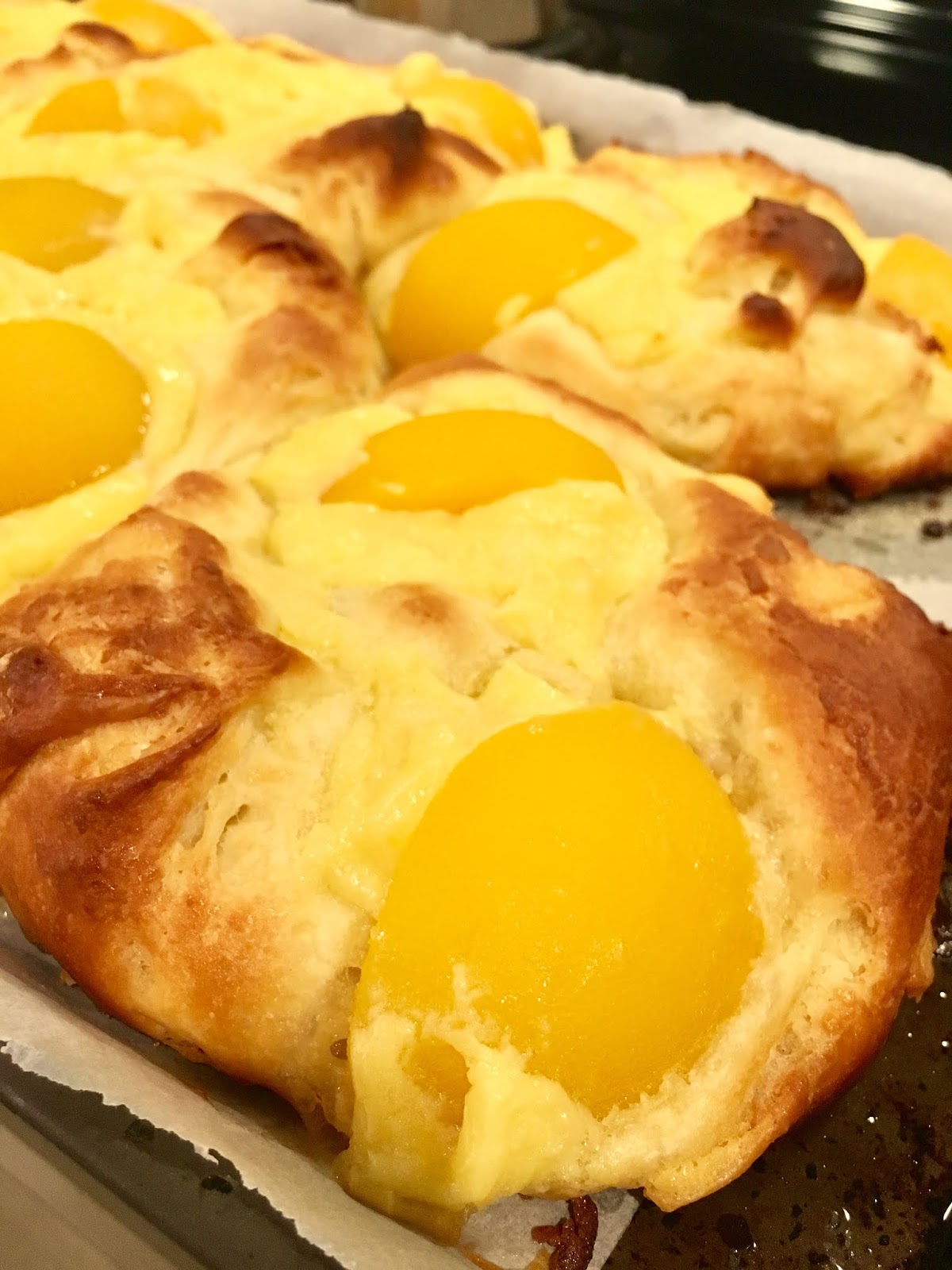
The danish pastry was originally brought to Denmark by Austrian bakers, in the Viennese tradition of laminating layers of sweet dough with lots of butter. This was our first time making Danishes and we decided to go for a peach and custard filling. Be warned that there are many steps to this recipe for peach danishes, and it will take the better part of a day.
Ingredients
1 tbsp active dry yeast
1 tbsp + 1/4 cup + 1/4 cup + 1/4 cup sugar
1/2 cup hot water
2 1/4 cups + 1 tbsp flour
1 tsp salt
2 eggs + 4 egg yolks + 1 egg
2 tbsp + 14 tbsp + 1 tbsp butter
1 1/2 cup milk
1/2 cup heavy cream
1/4 cup cornstarch
1 tsp vanilla
1 25 oz jar halved peaches, with each half cut in half
Directions
Make the dough: mix the yeast and 1 tbsp sugar in a small bowl and add 1/2 cup hot water (hottest from the tap). Let sit for 5 minutes until the yeast gets foamy.
In a large bowl, mix the flour, 1/4 cup sugar, salt, and 2 tbsp butter until the mixture resembles coarse crumbs.
Pour the yeast bowl into the flour bowl and mix until combined, then add 2 eggs and mix until it just comes together without over-mixing. Gently knead the dough for about 30 seconds to form a smooth ball, then wrap with cling wrap and refrigerate for at least 2 hours.
Mix the remaining 14 tbsp of butter with 1 tbsp flour. On a sheet of cling wrap, press into a rectangle about 5×6 inches long. Refrigerate this for 1-2 hours as well.

On a lightly floured board, roll out dough to rectangle 5×9 inches long and about 1/4 inch thick. Bring the butter mixture up to room temperature until it’s the same consistency as the dough, then place butter over 2/3 of the dough.
Fold the unbuttered third over the butter, like a piece of paper, followed by the last third, to lock in the butter. Then roll the whole thing out to a 5×9 inch rectangle and fold dough into thirds again. Put it in the fridge for 1 hour or the freezer for 20 minutes.
Repeat this rolling – folding – refrigerating cycle two more times to laminate the butter into the dough. Then wrap the dough in cling wrap and refrigerate for at least 4 hours.
While the dough is chilling, make the cream. In a small pot, heat the milk, cream, and 1/4 cup sugar over medium heat. Stir frequently until it starts to simmer.
In a separate bowl, whisk egg yolks, cornstarch, and 1/4 cup sugar. While still whisking, slowly pour the hot milk into the egg yolk mixture.
Once it’s fully incorporated, pour everything back into the pot and cook over medium-high heat, whisking constantly, for 2 minutes or until it thickens.
Remove from heat, stir in vanilla and 1 tbsp butter until it melts in, then cover with cling wrap and refrigerate for at least 2 hours. Stir up again before using.


After all the chilling is complete, roll out the dough on a lightly floured board to a 10-12 inch square, then cut the dough into six even squares.
Put a tablespoon of chilled cream onto the center of each square, and place two peach pieces over the cream in a diagonal line.
Fold one corner of the dough down towards the middle of the peaches, about 2/3 of the way toward the opposite corner, and press to hold the dough in place. Fold the opposite corner up to overlap it, and press gently to attach the two corners.
Repeat with the remaining squares and place on parchment-lined baking sheets. Cover let rise in a warm place for 45 minutes.
Brush dough with a beaten egg and bake at 375F for 20-25 minutes. Cool on a wire rack and serve at room temperature.


Leave a Reply